The Hejaz Railway: the line that ended in Medina
Stone workshops, a locomotive shed and a basalt platform, twenty minutes from the Prophet’s Mosque.
The Hejaz Railway was begun in 1900 under the Ottoman sultan Abdul Hamid II and reached Medina in 1908: roughly 1,300 kilometres of narrow-gauge track from Damascus, built to carry pilgrims who had until then crossed the same distance by camel over forty days or more. The train did it in four.
A large share of the cost came from public subscription: donations collected from Muslims across the Ottoman lands, in India, in Egypt, in Southeast Asia. It was, unusually for a railway of that period, not primarily a colonial commercial venture.
Eight years of service
The line carried pilgrims from 1908 until the First World War. During the Arab Revolt it became a military target, repeatedly attacked south of Ma’an, and it never resumed operating to Medina afterwards. Long stretches of track and dozens of intermediate stations were left in the desert, where a good number of them still stand.
Eight years is a short life for a project of that scale, and that is part of what makes the Medina terminus worth standing in. It is the end of a line that was only ever fully used for less than a decade.
The station today
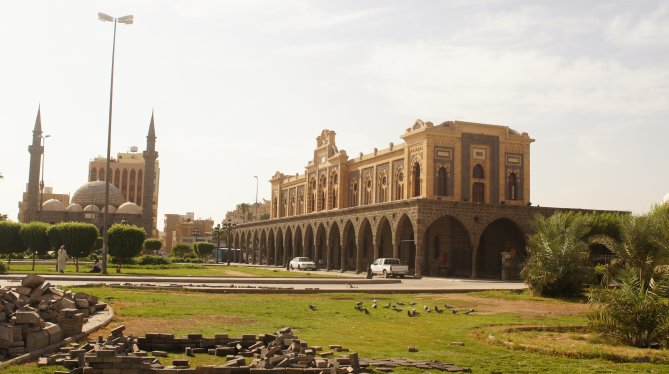
The Medina terminus is a compound of low stone buildings — the passenger hall, workshops, a locomotive shed — built in dark local stone with pale trim, in a restrained late-Ottoman style that looks nothing like the rest of the modern city. It has been restored and now houses a museum, with rolling stock on a short length of preserved track.
It is also, on most days, quiet. Nearly every visitor to Medina comes for the religious sites, which is entirely reasonable, and the result is that a substantial piece of the city’s industrial and imperial history has room to breathe.
Worth twenty minutes
We include the station on the Heritage Tour for twenty minutes, usually late in the route. Museum opening hours change, so we confirm on the day rather than promising an interior visit in advance — but the compound and the platform are worth the stop either way.