Inside the Qur’an printing complex: how the Madinah mushaf is made
One man wrote the master copy by hand. Everything after that is machinery.
The King Fahd Complex for the Printing of the Holy Qur’an stands on the western edge of Medina, off the road to Tabuk, about twenty minutes from the Haram in ordinary traffic. It opened in 1985. Since then it has produced more than three hundred million copies of the mushaf, along with translations, recordings and volumes of tafsir — a figure the complex publishes itself and revises upward each year.
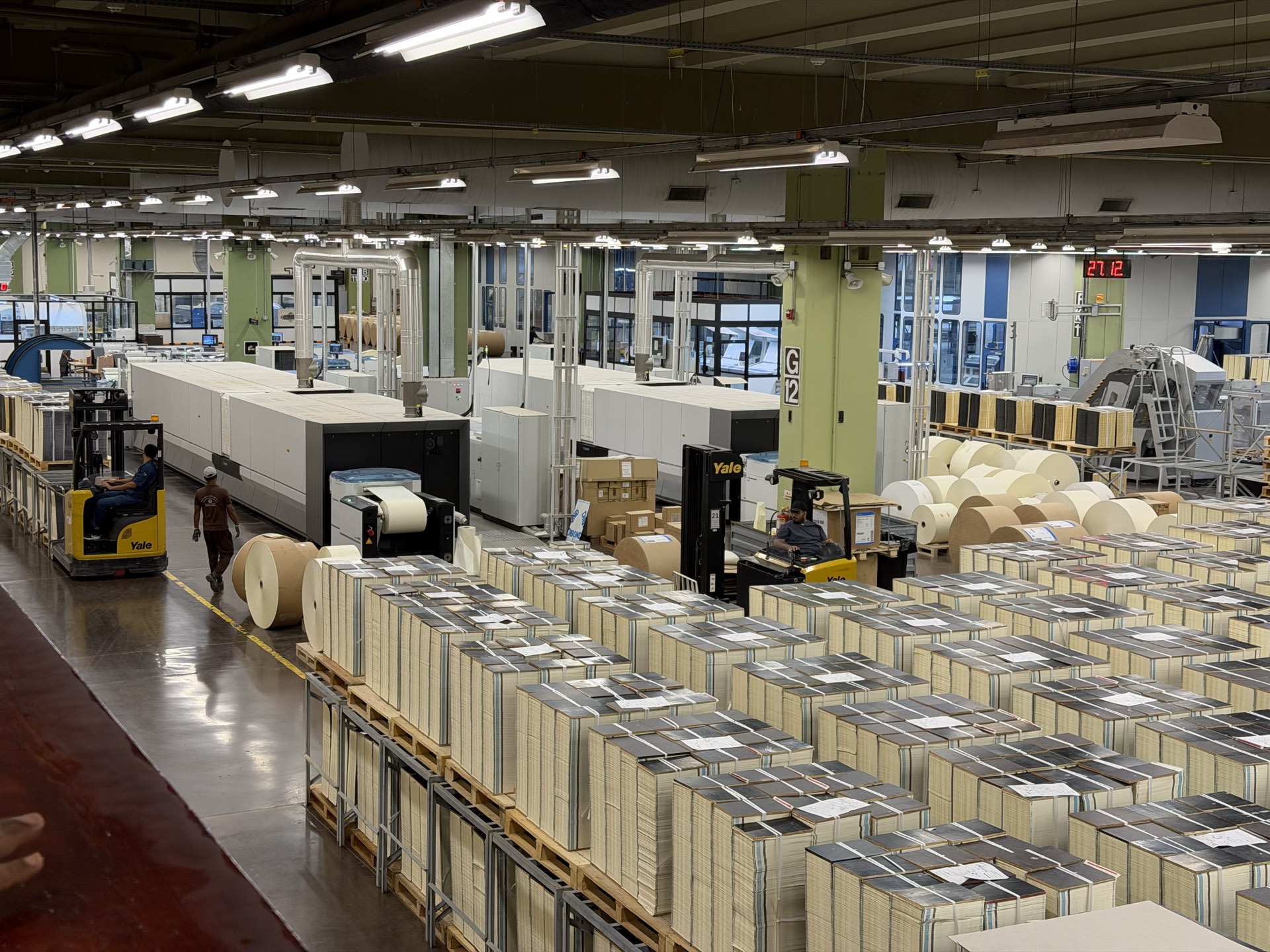
It is not a museum, which is the reason to go. It is a working factory, and the visitor route runs along a raised walkway above the floor while the presses are running underneath you.
One man’s handwriting
Almost every printed Qur’an you pick up in Medina — in a hotel room, on a mosque shelf, handed to you at the airport — is the same edition, and that edition is one person’s handwriting. Uthman Taha, a calligrapher born in Aleppo in 1934, moved to Saudi Arabia in 1988 to work at the complex. The Madinah mushaf reproduces his naskh script photographically.
A complete mushaf takes him over three years to write, and roughly a year more to be checked. Four of the copies he produced are reported to stand behind more than two hundred million printed books. It is worth holding that in mind on the walkway: everything moving beneath you is a reproduction of pages one man ruled and wrote out by hand.
What the floor looks like
Paper arrives in reels taller than the men handling them and leaves on pallets — hundreds of pallets, in ranks down the length of the hall, each one a strapped block of folded printed sheets waiting to be bound. The aisles are marked with letters and numbers, G2, H12, the way any large plant marks its aisles, and a digital clock on a pillar counts off something to do with the shift.
The impression most visitors describe is the plainness of it. There is no ceremony on the floor: a forklift reverses, someone walks a gangway with a clipboard, a machine folds and stacks without pausing. The only unusual thing is what is being folded and stacked.
The checking, which is the slow part
Printing is the fast half. The complex maintains a scholarly council and a standing committee whose work is to review the mushaf — the letter shapes, the dotting, the vowel marks, the pause signs, the page layout and the marginal notes. A manuscript goes from the calligrapher to that committee, and comes back.
The complex also runs a translations centre and states that it has issued translations of the meaning in more than seventy languages. A translation is reviewed the same way, which is why the work takes years rather than months. Whatever anyone thinks of a particular rendering, what made this the reference edition is the review, not the presses.
Visiting
Entry is free and always has been. Visits are arranged in advance through the complex’s own booking service, and arriving without one is the usual reason people are turned away at the gate.
Hours have changed more than once, so treat any schedule on a travel site as out of date until you have checked it. The long-standing pattern is mornings from Sunday to Thursday, with Friday closed or evenings only, and the complex has also run afternoon sessions. Allow about an hour.
Dress as you would for a mosque and expect a factory floor: closed shoes, stay with the group, and ask before photographing anything. Visitors are customarily given a copy of the mushaf on the way out, usually with a choice of language.
Why it earns a place on the itinerary
Most of what a visitor sees in Medina is a place where something happened a very long time ago and the building has been rebuilt around the memory of it. Quba, Uhud, Qiblatain — the value is in standing where it stood. This is the one stop where nothing historic happened and something is happening now, which is why it is often the visit people describe first when they get home.